
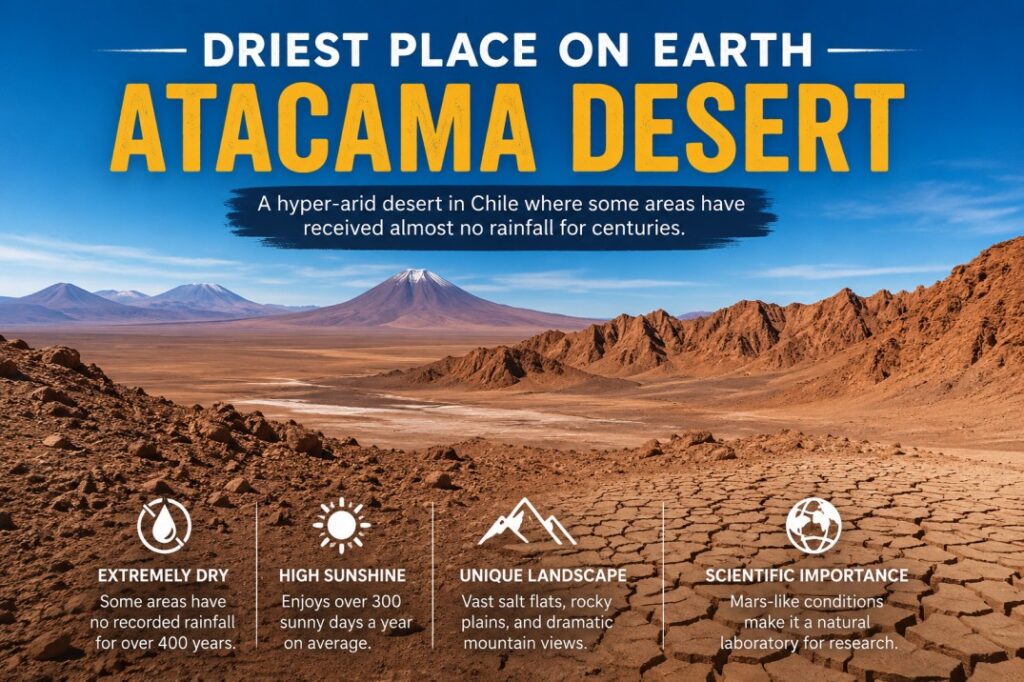
Our planet is full of fascinating places known for their extreme weather conditions and natural beauty. However, can you imagine a place where it hasn’t rained for not just years, but centuries? Welcome to the driest place on earth Atacama Desert, located in Chile.
This landscape is so arid and alienated that its environment resembles the surface of Mars rather than Earth. In this comprehensive guide, we will dive deep into the geographical mysteries and jaw-dropping facts that make the Atacama Desert one of the most unique places in the world.
Why Is the Atacama Desert So Dry? (The Science Behind It)
The Atacama Desert sits right next to the Pacific Ocean, which makes its absolute lack of rain quite paradoxical. The primary geographical reason behind this phenomenon is called the Rain Shadow Effect.The Andean Rain Shadow: The massive Andes Mountain range borders the Atacama Desert to the east.
When moisture-laden winds and clouds travel from the Amazon Basin, they cannot climb over these towering peaks. As a result, all the rain falls on the opposite side of the mountains.The Humboldt Current: On the ocean side, a cold water current flowing along the coast prevents the air from retaining moisture.
This stops the formation of rain clouds entirely.If you want to understand the deep scientific mechanics of the Rain Shadow Effect, you can visit to read the academic details.
Atacama Desert vs. Sahara Desert: A Clear Comparison
People often mistakenly assume that the largest hot desert is also the driest. The comparative table below highlights how unique the Atacama Desert truly is when compared to the famous Sahara:
Features. Atacama Desert. Sahara Desert official Status Driest Non-Polar Desert. Largest Hot Desert Average Rainfall. 1 mm to 3 mm per Year Around 100 mm per year
As clearly demonstrated by the data, the driest place on earth Atacama Desert receives negligible precipitation compared to the Sahara. In fact, some specific weather stations in the heart of the Atacama have recorded no rainfall at all for over 400 years!
Shocking Facts That Make driest place on earth Atacama Desert Unique
1. NASA Conducts Mars Rover Testing Here
Because the soil structure and hyper-arid environment of the driest place on earth Atacama Desert are nearly identical to the red planet, organic life and bacteria can barely survive here. Consequently, NASA uses this location to test out automated rovers and scientific instruments before launching them to Mars.
2. An Astronomer’s Paradise (The Clearest Skies on Earth)
Due to zero cloud cover, high altitudes, and dry air, the night sky over the driest place on earth Atacama Desert is the clearest in the world. With absolutely no light pollution, major international scientific institutions have established the world’s most advanced telescopes here (such as the ALMA Telescope array ) to peer deep into distant galaxies.
3. The Hand of the Desert (Mano del Desierto)
Rising unexpectedly out of the desolate desert floor is a stunning 36-foot-tall iron and concrete sculpture of a human hand. Built by artist Mario Irarrázabal, this striking landmark looks like a giant hand reaching out from the earth, serving as a popular tourist attraction for travelers driving along the Pan-American Highway.
How Do People and Wildlife Survive Here?
Despite experiencing some of the most extreme climatic conditions on the planet, the Atacama Desert is home to roughly 1 million people.
How Do People and Wildlife Survive Here?
Despite experiencing some of the most extreme climatic conditions on the planet, the Atacama Desert is home to roughly 1 million people.
The Fog Catching Technique:
Since it never rains, local communities harvest water directly from the sky using giant nets. As dense fog (known locally as camanchaca) rolls in from the coast in the morning, it gets trapped by the mesh nets and condenses into clean water droplets, which are then channeled into storage tanks via pipelines.
Unique Wildlife: The region also supports highly adapted animals. Specialized species of Flamingos and Humboldt Penguins can be found living near the hypersaline lagoons and salt flats located within the desert borders.
If you enjoy reading about extreme survival environments, you can also check out our previous article
Since it never rains, local communities harvest water directly from the sky using giant nets. As dense fog (known locally as camanchaca) rolls in from the coast in the morning, it gets trapped by the mesh nets and condenses into clean water droplets, which are then channeled into storage tanks via pipelines.
Unique Wildlife: The region also supports highly adapted animals. Specialized species of Flamingos and Humboldt Penguins can be found living near the hypersaline lagoons and salt flats located within the desert borders.If you enjoy reading about extreme survival environments, you can also check out our previous article .
Conclusion: A Masterpiece of Natural Geography.
The driest place on earth Atacama Desert is a powerful reminder of how diverse and extreme Earth’s geography can be. The vast contrast of having a hyper-arid desert sit right next to a massive ocean is what makes it a scientific wonder. For anyone who loves travel and earth sciences, studying the Atacama is an incredibly thrilling experience.
FAQs (Frequently Asked Questions):
1. Do people actually live in the Atacama Desert?
Yes, cities like Antofagasta and smaller oasis towns thrive inside the driest place on earth Atacama Desert by utilizing natural spring oases and innovative fog-harvesting networks.
2. Which country is the Atacama Desert located in?
Driest place on earth Atacama Desert is located in the northern region of Chile in South America.
3. Is the Atacama Desert extremely hot?
Unlike the Sahara, the Atacama is a relatively cool desert. Because of its high altitude and cold ocean currents, daytime temperatures are mild, and night temperatures frequently drop below freezing
For more updates, visit the StudyVRS