
Monsoon Season
What is the Monsoon?
The monsoon is a seasonal wind system that changes direction due to differences in heating between land and sea. It brings heavy rainfall to many countries, especially India and South Asia.
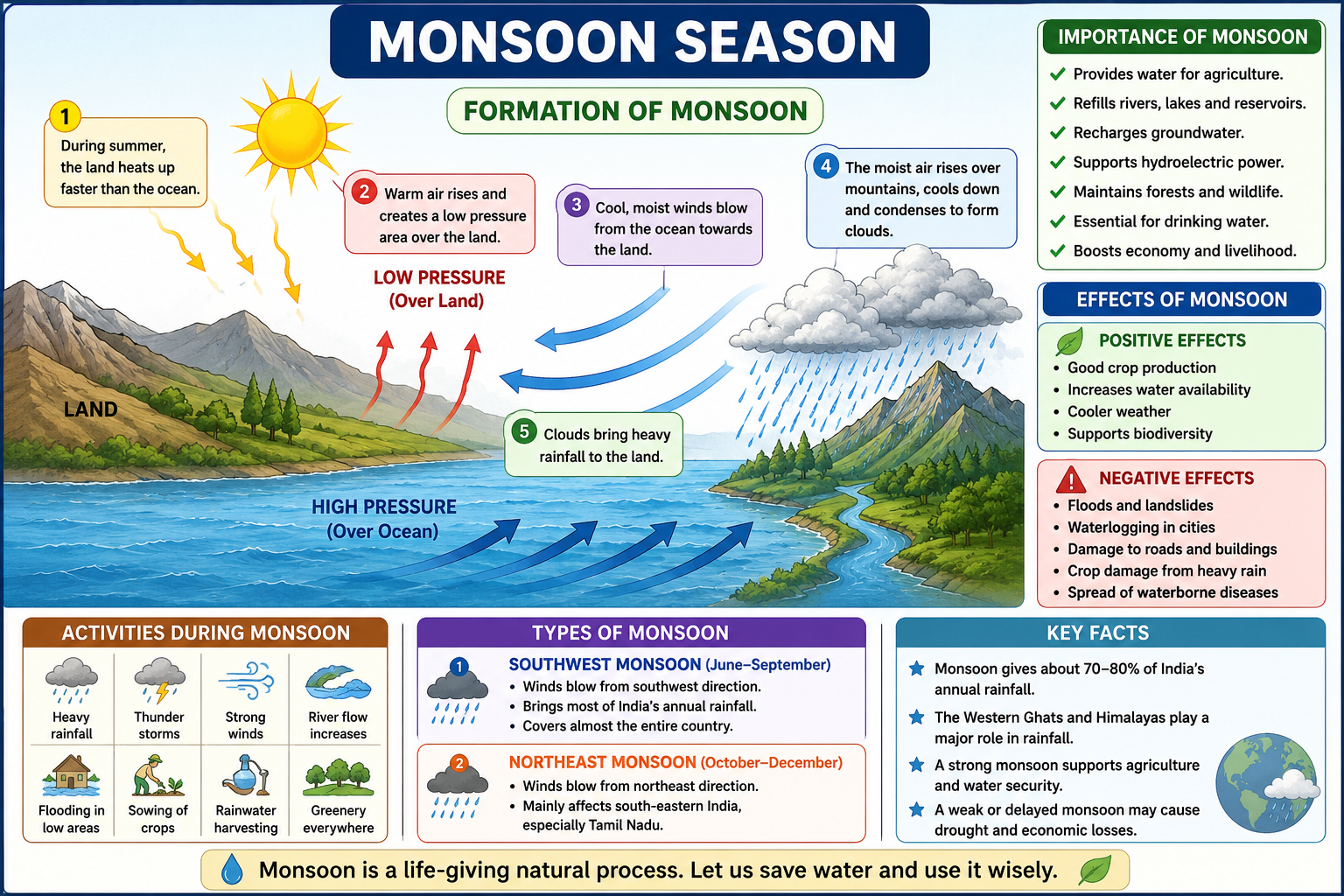
Formation of the Monsoon
1. During summer, land heats up faster than the ocean.
2. A low-pressure area forms over the land.
3. The ocean remains cooler, creating a high-pressure area.
4. Moist winds blow from the sea toward the land.
5. As these winds rise over mountains, the moisture condenses into clouds and causes rainfall.
Importance of the Monsoon
Provides water for agriculture.
Refills rivers, lakes, and reservoirs.
Recharges groundwater.
Supports hydroelectric power generation.
Maintains forests and wildlife.
Supplies drinking water.
Contributes significantly to the economy.
Effects of the Monsoon
Positive Effects
Good crop production.
Increased water availability.
Cooler temperatures.
Improved biodiversity.
Negative Effects
Floods and landslides.
Waterlogging in cities.
Damage to roads, bridges, and buildings.
Crop damage from excessive rainfall.
Spread of waterborne diseases.
Monsoon Activities
Heavy rainfall and thunderstorms.
Cloud formation.
Strong winds.
River flow increases.
Flooding in low-lying areas.
Agricultural activities such as sowing rice, maize, and cotton.
Rainwater harvesting.
Increased greenery and vegetation growth.
Types of Monsoon
Southwest Monsoon (June–September): Brings most of India’s annual rainfall.
Northeast Monsoon (October–December): Mainly affects southeastern India, especially Tamil Nadu.
Key Facts
The monsoon supplies about 70–80% of India’s annual rainfall.
The Western Ghats and Himalayas play a major role in influencing rainfall patterns.
A strong monsoon supports agriculture and water security, while a weak or delayed monsoon can lead to drought and economic losses.
Frequently Asked Questions (FAQs)
Q1. What is the monsoon season?
Answer: The monsoon season is a period of seasonal winds that bring heavy rainfall due to changes in air pressure and temperature between land and sea.
Q2. How is the monsoon formed?
Answer: During summer, land heats up faster than the sea, creating low pressure over land. Moist air from the ocean moves inland, rises, cools, and forms rain clouds, resulting in monsoon rainfall.
Q3. Why is the monsoon important?
Answer: The monsoon is essential because it provides water for agriculture, drinking, hydroelectric power, rivers, lakes, and groundwater recharge. It also supports ecosystems and the economy.
Q4. What are the positive effects of the monsoon?
Answer: The monsoon improves crop production, increases water availability, cools temperatures, and promotes the growth of forests and vegetation.
Q5. What are the negative effects of the monsoon?
Answer: Heavy monsoon rains can cause floods, landslides, waterlogging, crop damage, transportation disruptions, and the spread of waterborne diseases.
Q6. Which months does the monsoon occur in India?
Answer: The Southwest Monsoon usually lasts from June to September, while the Northeast Monsoon occurs mainly from October to December in southeastern India.
Q7. What are the main types of monsoon?
Answer: The two main types are the Southwest Monsoon and the Northeast Monsoon.
Q8. Which crops depend on the monsoon?
Answer: Crops such as rice, maize, cotton, soybean, sugarcane, and pulses depend heavily on monsoon rainfall.
Q9. What causes floods during the monsoon?
Answer: Floods occur when intense rainfall exceeds the capacity of rivers, lakes, and drainage systems, causing water to overflow into surrounding areas.
Q10. How can we reduce the impact of monsoon floods?
Answer: Flood impacts can be reduced through proper drainage systems, rainwater harvesting, flood forecasting, afforestation, and responsible land-use planning.