
Photosynthesis is the process by which green plants, algae, and some bacteria make their own food using sunlight, water, and carbon dioxide. This process takes place mainly in the leaves of green plants.
What is needed for photosynthesis?
Photosynthesis requires four main things:
1. Sunlight – It provides the energy needed to make food.
2. Water (H₂O) – It is absorbed from the soil by the roots.
3. Carbon dioxide (CO₂) – It enters the leaves through tiny openings called stomata.
4. Chlorophyll – A green pigment found in the chloroplasts of leaf cells. It absorbs sunlight.
How does photosynthesis happen?
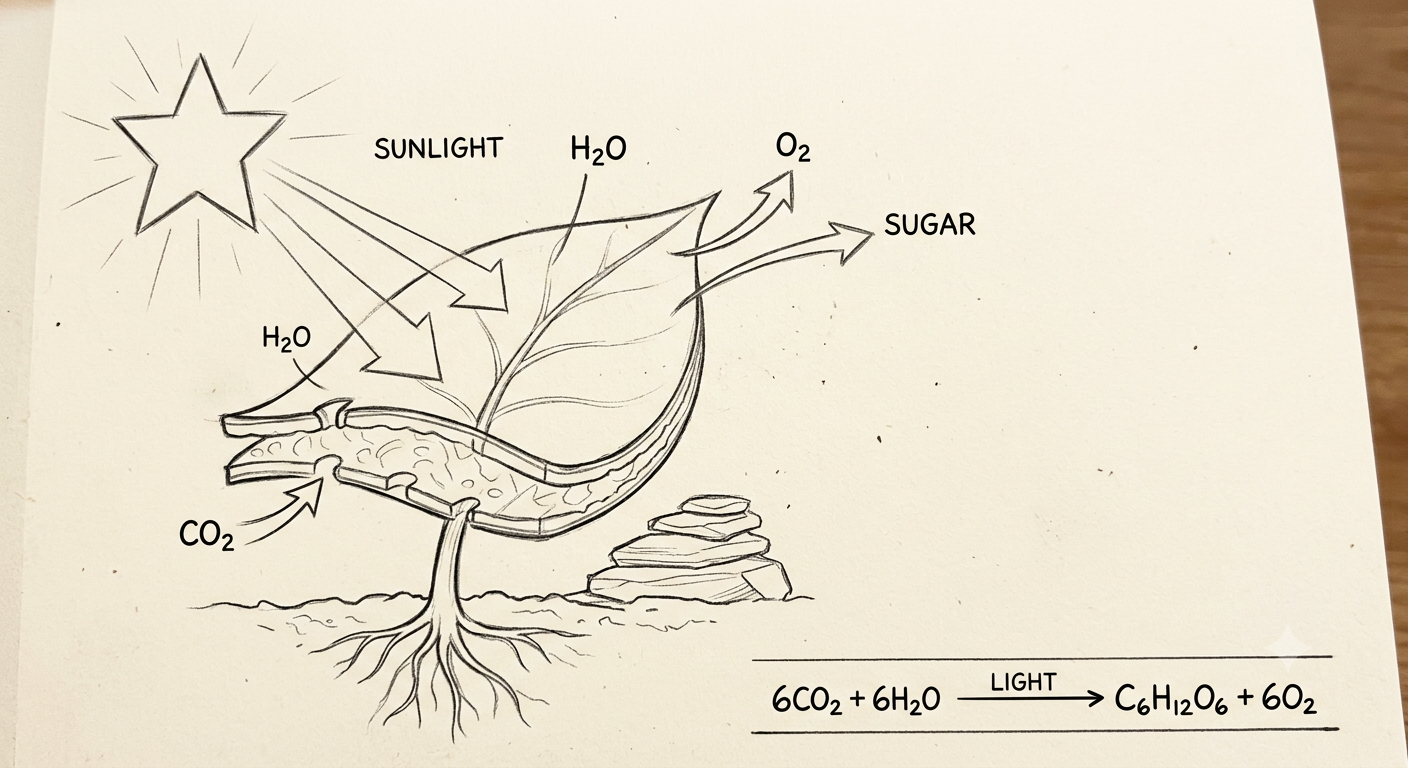
1. The roots absorb water from the soil and transport it to the leaves.
2. The leaves take in carbon dioxide from the air through the stomata.
3. Chlorophyll absorbs energy from sunlight.
4. Using this energy, the plant changes water and carbon dioxide into glucose (food).
5. During this process, oxygen is produced and released into the air through the stomata.
Products of photosynthesis
Photosynthesis produces:
Glucose (C₆H₁₂O₆): The food used for energy, growth, and stored as starch.
Oxygen (O₂): Released into the atmosphere for humans and animals to breathe.
Importance of photosynthesis
It provides food for plants.
It releases oxygen, which is essential for life.
It removes carbon dioxide from the atmosphere.
It is the primary source of food and energy for almost all living organisms.
It helps maintain the balance of gases in the atmosphere.
Factors affecting photosynthesis
The rate of photosynthesis depends on:
Light intensity – More light increases the rate up to a certain limit.
Carbon dioxide concentration – More CO₂ generally increases the rate.
Temperature – Moderate temperatures are best because enzymes work most efficiently then.
Water availability – A lack of water slows or stops photosynthesis.
Simple word equation
Carbon dioxide + Water + Sunlight → Glucose + Oxygen
Summary
Photosynthesis is the process by which green plants use sunlight, water, and carbon dioxide to produce glucose, their food, and release oxygen into the atmosphere. It is one of the most important biological processes because it provides food and oxygen for life on Earth.
Frequently asked questions
1. What is photosynthesis?
Photosynthesis is the process by which green plants use sunlight, water, and carbon dioxide to make their own food (glucose) and release oxygen.
2. Where does photosynthesis take place?
Photosynthesis takes place mainly in the leaves of green plants, inside the chloroplasts that contain chlorophyll.
3. What are the raw materials required for photosynthesis?
The raw materials required for photosynthesis are:
Carbon dioxide (CO₂)
Water (H₂O)
Sunlight
Chlorophyll
4. What are the products of photosynthesis?
The products of photosynthesis are:
Glucose (C₆H₁₂O₆) – Food for the plant
Oxygen (O₂) – Released into the atmosphere
5. Why is photosynthesis important?
Photosynthesis is important because it provides food for plants, releases oxygen for living organisms, removes carbon dioxide from the atmosphere, and helps maintain ecological balance.
6. What is the chemical equation of photosynthesis?
6CO₂ + 6H₂O + Light Energy → C₆H₁₂O₆ + 6O₂
7. Which pigment is responsible for photosynthesis?
Chlorophyll is the green pigment responsible for absorbing sunlight during photosynthesis.
8. What factors affect the rate of photosynthesis?
The main factors are:
Light intensity
Carbon dioxide concentration
Temperature
Water availability