
Introduction
The Earth provides clean air, fresh water, fertile soil, and a stable climate that support all living organisms. However, increasing human activities such as deforestation, pollution, overuse of natural resources, and greenhouse gas emissions are putting immense pressure on the planet. To understand these environmental limits, scientists developed the Planetary Boundaries framework.
This concept helps us identify the safe environmental limits within which humanity can continue to develop without causing irreversible damage to Earth’s natural systems.
What are Planetary Boundaries?
Planetary Boundaries are scientifically defined environmental limits that keep Earth’s systems stable and suitable for human life. If these boundaries are crossed, the risk of severe environmental changes increases significantly.
Definition:
Planetary Boundaries are the safe operating limits of Earth’s major environmental systems that humanity should not exceed to maintain a stable and sustainable planet.
Why are Planetary Boundaries Important?
Planetary boundaries help scientists, governments, and societies understand how human activities affect the Earth’s environment. They provide guidance for sustainable development and environmental conservation.
Importance
Protects biodiversity.
Reduces climate change risks.
Maintains healthy ecosystems.
Ensures food and water security.
Supports sustainable economic development.
Protects future generations.
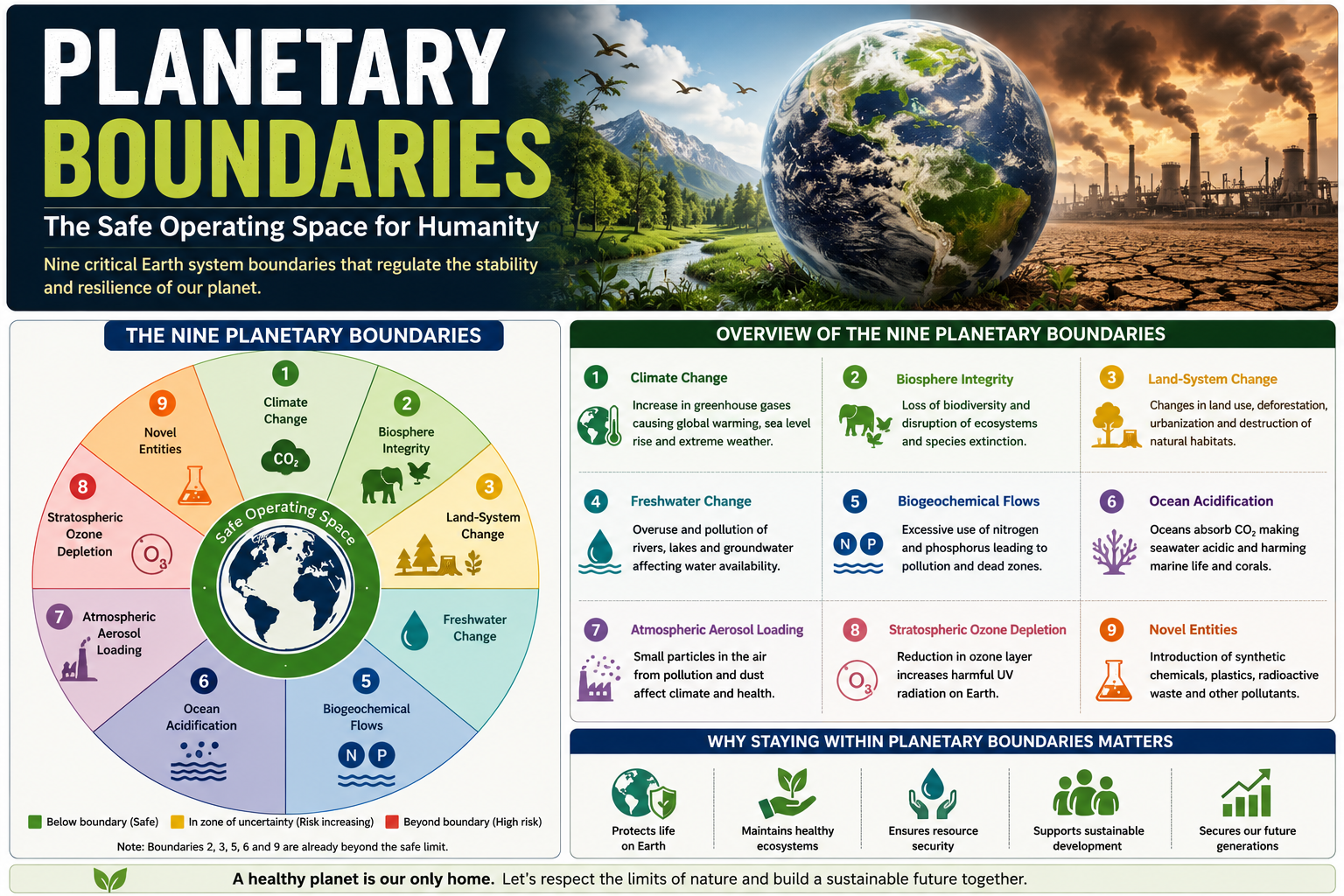
The Nine Planetary Boundaries
1. Climate Change
Increasing greenhouse gases warm the Earth, causing rising temperatures, melting glaciers, sea-level rise, and extreme weather events.
2. Biosphere Integrity
The loss of plants, animals, and microorganisms reduces biodiversity and weakens ecosystems.
3. Land-System Change
Deforestation, urbanization, and agricultural expansion destroy natural habitats and reduce ecological balance.
4. Freshwater Change
Overuse of rivers, lakes, and groundwater causes water shortages and damages aquatic ecosystems.
5. Biogeochemical Flows
Excessive use of nitrogen and phosphorus fertilizers pollutes water bodies and creates dead zones in lakes and oceans.
6. Ocean Acidification
The oceans absorb excess carbon dioxide, making seawater more acidic and harming corals and marine organisms.
7. Atmospheric Aerosol Loading
Dust, smoke, and industrial pollutants affect climate, rainfall patterns, and human health.
8. Stratospheric Ozone Depletion
The ozone layer protects life from harmful ultraviolet (UV) radiation. Although it is recovering due to global action, it remains an important planetary boundary.
9. Novel Entities
These include plastics, pesticides, industrial chemicals, radioactive waste, and other human-made substances that accumulate in the environment.
Current Status
Scientific research indicates that several planetary boundaries have already been exceeded due to human activities. Climate change, biodiversity loss, land-system change, excessive nutrient pollution, freshwater alteration, and novel entities are among the most affected boundaries. Crossing these limits increases the risk of environmental instability.
Human Activities Affecting Planetary Boundaries
Burning fossil fuels
Deforestation
Industrial pollution
Plastic waste
Intensive agriculture
Overfishing
Mining
Rapid urbanization
Overconsumption of natural resources
Solutions
Reduce greenhouse gas emissions.
Protect forests and wetlands.
Use renewable energy sources.
Reduce plastic pollution.
Promote sustainable agriculture.
Conserve freshwater resources.
Improve recycling and waste management.
Protect wildlife and biodiversity.
Encourage sustainable lifestyles.
Advantages of Understanding Planetary Boundaries
Better environmental planning
Improved conservation strategies
Sustainable use of natural resources
Reduced climate risks
Stronger environmental policies
Greater public awareness
Conclusion
Planetary Boundaries provide a scientific framework for understanding the environmental limits of our planet. Staying within these boundaries is essential for protecting ecosystems, ensuring sustainable development, and maintaining a healthy Earth for present and future generations. Governments, industries, and individuals all have an important role in keeping humanity within this safe operating space.
Frequently Asked Questions (FAQs)
Q1. What are Planetary Boundaries?
Planetary Boundaries are environmental limits that define the safe operating space for humanity.
Q2. How many Planetary Boundaries are there?
There are nine scientifically identified planetary boundaries.
Q3. Why are Planetary Boundaries important?
They help prevent irreversible environmental damage and support sustainable development.
Q4. Which planetary boundaries have already been crossed?
Research indicates that climate change, biodiversity loss, land-system change, freshwater change, biogeochemical flows, and novel entities have exceeded their safe limits.
Q5. How can we protect Planetary Boundaries?
By reducing pollution, conserving biodiversity, protecting forests, using renewable energy, and adopting sustainable lifestyles.
Solutions
Reduce greenhouse gas emissions.
Protect forests and wetlands.
Use renewable energy sources.
Reduce plastic pollution.
Promote sustainable agriculture.
Con