
What is Monsoon?
A monsoon is a seasonal wind system that changes direction during different times of the year, bringing significant changes in rainfall and weather. The word monsoon comes from the Arabic word “mausim,” which means “season.”
The monsoon season occurs because land heats up and cools down faster than the ocean. During summer, warm air over land creates a low-pressure area that pulls in moist air from the sea.
As this moist air rises and cools, it forms clouds and produces heavy rainfall. In winter, the wind direction reverses, often bringing dry weather to many regions.Monsoons are most common in South Asia, Southeast Asia, East Asia, Africa, and northern Australia. They play a crucial role in agriculture, water supply, ecosystems, and the economy by providing the rainfall needed for crops, rivers, and groundwater.
This seasonal weather pattern is one of the most important climate systems on Earth, affecting the lives of billions of people each year.
Formation of Monsoon
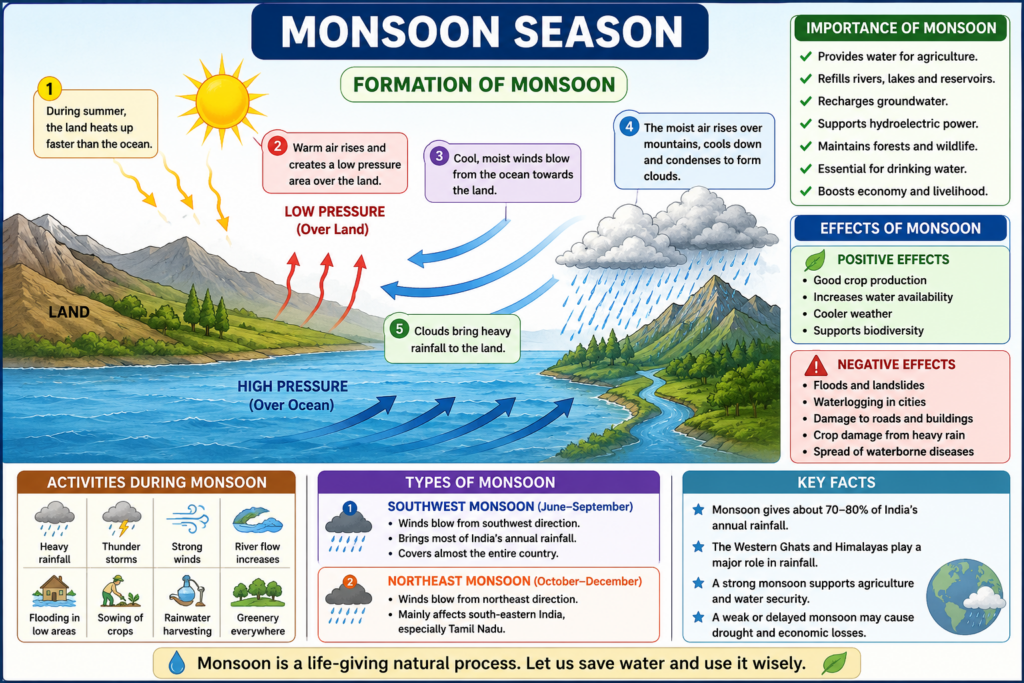
The formation of monsoon is a seasonal process driven by differences in temperature and air pressure between land and sea. Several atmospheric factors work together to create the monsoon circulation that brings seasonal rainfall.
1. Differential Heating of Land and SeaDuring summer, land heats up much faster than the ocean. The hot land creates a low-pressure area, while the relatively cooler ocean remains a high-pressure area.
2. Movement of Moist AirAir always moves from high pressure to low pressure. As a result, moisture-laden winds blow from the ocean toward the land.
3. Rising of Warm AirWhen these moist winds reach the heated land, the warm air rises into the atmosphere. As it rises, it cools and water vapor begins to condense.
4. Cloud Formation and RainfallThe condensed water vapor forms clouds. When the clouds become saturated, they produce heavy monsoon rainfall over large areas.
5. Role of the ITCZThe Intertropical Convergence Zone (ITCZ) shifts northward during summer. This shift strengthens the inflow of moist winds and helps develop the monsoon.
6. Influence of the HimalayasThe Himalayan Mountains block the moisture-laden winds from moving farther north. This forces the air to rise, enhancing cloud formation and increasing rainfall over the Indian subcontinent.
7. Reversal in WinterDuring winter, the land cools faster than the sea, creating high pressure over land and lower pressure over the ocean. The winds reverse direction, blowing from land to sea, which results in dry conditions in many regions.
The formation of monsoon is controlled by unequal heating of land and sea, seasonal pressure differences, the movement of the ITCZ, moisture-bearing winds, and the Himalayan Mountains. Together, these factors create the seasonal wind system responsible for monsoon rainfall.
Types of Monsoon
The types of monsoon are classified based on the direction of seasonal winds and the time of the year. The two main types of monsoon are the Southwest Monsoon and the Northeast Monsoon.
1. Southwest Monsoon (Summer Monsoon)The Southwest Monsoon occurs from June to September. During this period, moist winds blow from the Indian Ocean, Arabian Sea, and Bay of Bengal toward the Indian subcontinent. These winds bring heavy rainfall to India, Bangladesh, Nepal, Bhutan, and nearby regions.
Key Features:
Occurs during summer (June–September)Moist winds blow from sea to landBrings 70–80% of annual rainfall in IndiaEssential for agriculture and water resources
2. Northeast Monsoon (Winter Monsoon)The Northeast Monsoon occurs from October to December. During winter, winds reverse direction and blow from land to sea. Most regions remain dry, but Tamil Nadu and southeastern India receive significant rainfall from these winds after they pass over the Bay of Bengal
Key Features
:Occurs during winter (October–December)Winds blow from land to Sea rainfall mainly in Tamil Nadu and southeastern India also called the Winter Monsoon Difference Between Southwest and Northeast Monsoon feature Southwest Monsoon Northeast Monsoon season June–September October–December wind Direction Sea to Land Land to Sea rainfall Heavy Moderate (mainly southeastern India)Main Regions Most of India and South Asia Tamil Nadu and nearby areas.
characterstic of Monsoon
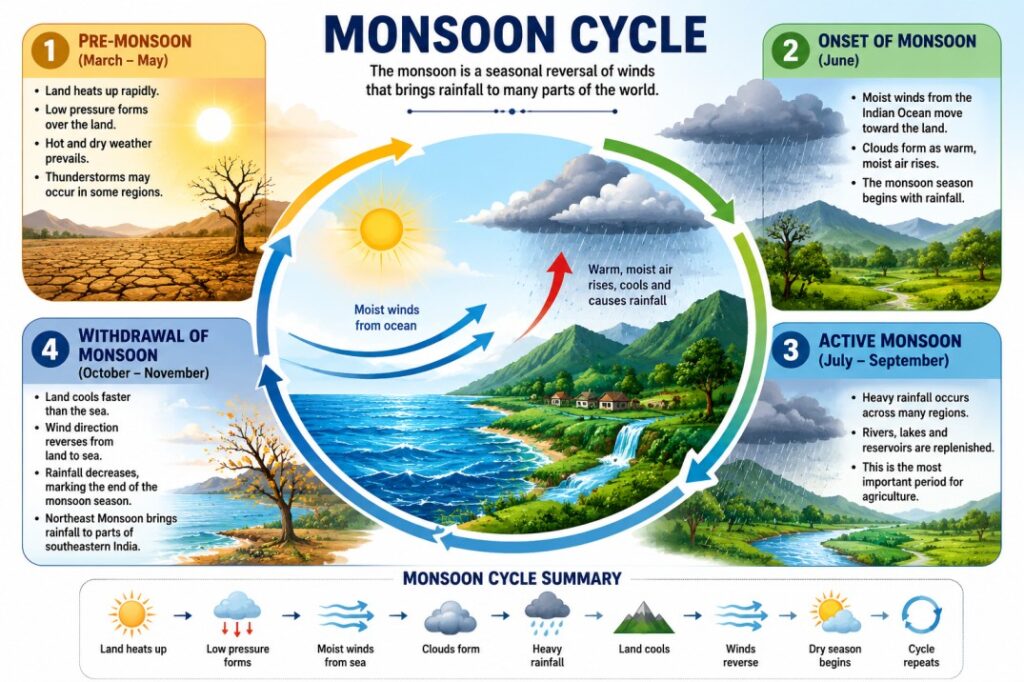
The characteristics of monsoon describe the unique features of the monsoon season that distinguish it from other weather systems. These characteristics influence climate, agriculture, water resources, and ecosystems in many parts of the world.
1. Seasonal Reversal of WindsThe most important characteristic of the monsoon season is the seasonal reversal of wind direction. During summer, winds blow from the sea to the land, while in winter, they reverse and blow from the land to the sea.
2. Heavy RainfallThe monsoon season is associated with heavy and widespread rainfall. Moisture-laden winds from the oceans bring abundant precipitation, especially in tropical and subtropical regions.
3. Uneven Distribution of RainfallRainfall during the monsoon season is not evenly distributed. Some regions receive very heavy rainfall, while others experience low or irregular rainfall due to geographical and atmospheric conditions.
4. High HumidityThe monsoon season is characterized by high humidity because of the large amount of moisture present in the atmosphere. This often makes the weather feel warm and humid.
5. Distinct Wet and Dry SeasonsMonsoon regions usually experience two clearly defined seasons: a wet season with heavy rainfall and a dry season with little or no rainfall.
6. Variable Onset and WithdrawalThe arrival and retreat of the monsoon season vary from year to year. Atmospheric and oceanic conditions can cause the monsoon to begin earlier or later than usual.
7. Strong Influence on ClimateThe monsoon season significantly affects temperature, humidity, cloud cover, and weather patterns, making it one of the most important climate systems in the world.
8. Importance for Agriculture a key characteristic of the monsoon season is its strong influence on agriculture. Timely and adequate rainfall supports crop growth, while weak or excessive rainfall can reduce agricultural productivity.
IMPORTANCE OF Monsoon
The importance of monsoon extends beyond rainfall. It plays a vital role in agriculture, water resources, ecosystems, energy production, and the economy. Millions of people depend on the monsoon season for their livelihood and daily needs.
1. Supports Agriculture the monsoon season provides the rainfall needed to grow crops such as rice, wheat, maize, sugarcane, and cotton. A good monsoon leads to higher agricultural productivity and food security.
2. Recharges Water ResourcesMonsoon rainfall fills rivers, lakes, reservoirs, and dams. It also replenishes groundwater, ensuring a reliable supply of drinking water and irrigation.
3. Maintains EcosystemsThe importance of monsoon is evident in forests, wetlands, and grasslands. Seasonal rainfall supports biodiversity by providing water and suitable habitats for plants and animals.
4. Generates Hydroelectric PowerMany hydroelectric power plants rely on water stored during the monsoon season. Adequate rainfall increases electricity generation and supports sustainable energy production.
5. Regulates ClimateThe monsoon season helps regulate regional temperatures, humidity, and weather patterns. It cools the land after hot summer months and influences the climate across South Asia.
6. Boosts the EconomyA successful monsoon season benefits agriculture, fisheries, transportation, and industries that depend on water. It contributes significantly to economic growth in many countries.
7. Improves Drinking Water Supply rainfall during the monsoon season replenishes reservoirs and groundwater, providing clean water for households, agriculture, and industries.
Frequently Asked Questions (FAQs)
Q1. What is the monsoon season?
Answer: The monsoon season is a period of seasonal winds that bring heavy rainfall due to changes in air pressure and temperature between land and sea.
Q2. How is the monsoon formed?
Answer: During summer, land heats up faster than the sea, creating low pressure over land. Moist air from the ocean moves inland, rises, cools, and forms rain clouds, resulting in monsoon rainfall.
Q3. Why is the monsoon important?
Answer: The monsoon is essential because it provides water for agriculture, drinking, hydroelectric power, rivers, lakes, and groundwater recharge. It also supports ecosystems and the economy.
Q4. What are the positive effects of the monsoon?
Answer: The monsoon improves crop production, increases water availability, cools temperatures, and promotes the growth of forests and vegetation.
Q5. What are the negative effects of the monsoon?
Answer: Heavy monsoon rains can cause floods, landslides, waterlogging, crop damage, transportation disruptions, and the spread of waterborne diseases.
Q6. Which months does the monsoon occur in India?
Answer: The Southwest Monsoon usually lasts from June to September, while the Northeast Monsoon occurs mainly from October to December in southeastern India.
Q7. What are the main types of monsoon?
Answer: The two main types are the Southwest Monsoon and the Northeast Monsoon.
Q8. Which crops depend on the monsoon?
Answer: Crops such as rice, maize, cotton, soybean, sugarcane, and pulses depend heavily on monsoon rainfall.
Q9. What causes floods during the monsoon?
Answer: Floods occur when intense rainfall exceeds the capacity of rivers, lakes, and drainage systems, causing water to overflow into surrounding areas.
Q10. How can we reduce the impact of monsoon floods?
Answer: Flood impacts can be reduced through proper drainage systems, rainwater harvesting, flood forecasting, afforestation, and responsible land-use planning.